The Questions Every Business Should Ask Customers

Most businesses invest significant time and money acquiring new customers.
- You print business cards.
- You build a website.
- You run advertising campaigns.
- You attend networking events.
- You “experiment” with digital marketing.
All of this activity has the same goal: persuading someone to buy from you for the first time.
But once that first sale is complete, many businesses unintentionally shift their focus straight back to prospecting.
In doing so, they overlook one of the most important principles of sustainable growth:
Retaining an existing customer is usually far more profitable than acquiring a new one.
Research from Bain & Company shows that increasing customer retention by just 5% can increase profits by between 25% and 95%. Despite this, many organisations treat each sale as a one-off transaction rather than the start of a longer relationship.
If you have already invested time and money winning a customer, the real opportunity is not simply making the first sale – it is creating the conditions for many more.
And the simplest place to start is by asking a few honest questions.
Why Customer Engagement Matters
Customer engagement has become one of the defining themes of modern marketing.
In competitive markets, products and services often become similar over time. What differentiates successful businesses is frequently the quality of the relationship they build with customers.
This relationship is shaped by communication, responsiveness, and the ability to understand what customers actually want.
However, research consistently shows that many organisations overestimate how well they are doing.
For example, PwC’s Global Customer Experience Survey regularly finds that while a majority of companies believe they provide excellent customer experiences, a much smaller proportion of customers agree.
This disconnect often happens because businesses assume they understand their customers, rather than actively asking them.
Customer feedback closes that gap.
The Value of Customer Feedback
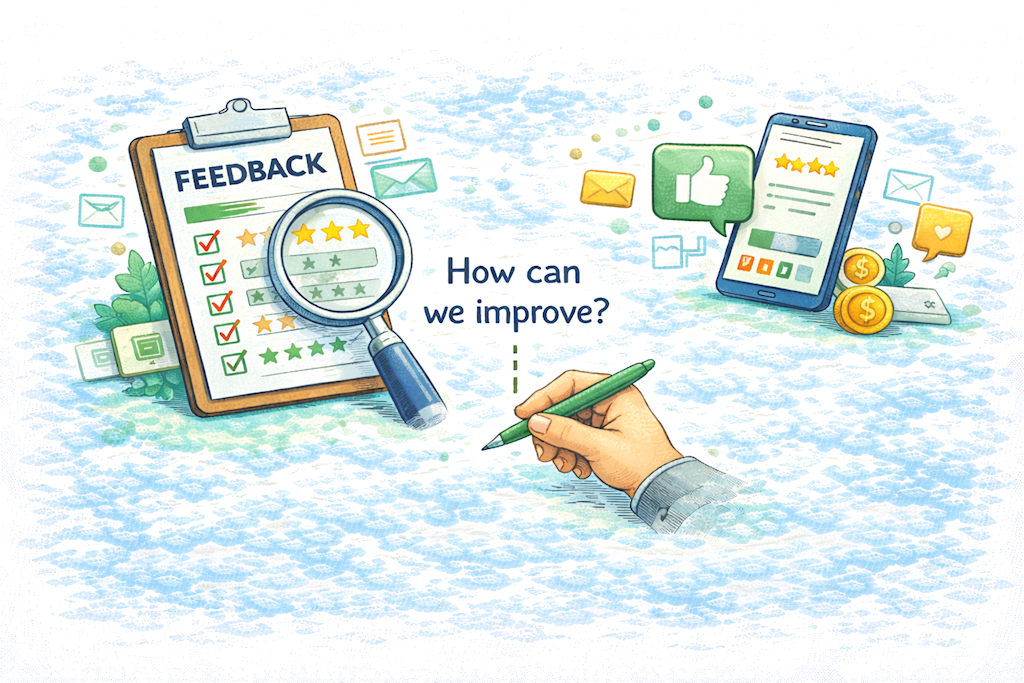
Customer feedback is one of the most powerful forms of market intelligence available to any business.
When used properly, it can reveal:
- What customers value most about your product or service
- Where expectations are not being met
- Which improvements would have the greatest impact on loyalty
- What differentiates your business from competitors
In other words, customer feedback provides insight that marketing data alone cannot always deliver. It helps businesses see themselves through the eyes of their customers. It is that perspective is often where the most useful improvements begin.
The Feedback Most Businesses Avoid
When organisations ask customers for feedback, there is a natural temptation to focus on positive responses. Praise is encouraging and it validates the effort teams have invested in delivering products or services. However, the most valuable insights usually come from the more difficult answers.
Critical feedback highlights the moments where expectations were not met. Those moments may reveal small operational problems, communication gaps, or opportunities to improve the customer experience and businesses that actively seek this feedback tend to improve faster than those that avoid it. Why? While compliments make us feel good, constructive criticism makes us better!
The Internet Has Changed Customer Conversations
The importance of customer feedback has increased significantly in the digital age.
In the past, a dissatisfied customer might have told a few friends or colleagues about a bad experience.
Today, that same customer might:
- Post a public review
- Comment on social media
- Write about their experience on an industry forum
- Share feedback on platforms such as Google Reviews or Trustpilot
A single message can reach hundreds or thousands of people very quickly indeed! Of course, the same effect applies to positive experiences. Customers who are delighted with a service or product can become powerful advocates for the brand, the trouble is… how often does THAT happen? We all know that bad news travels faster than good. This all makes understanding customer sentiment more important than ever and listening early helps businesses respond before issues escalate and helps amplify the positive experiences worth sharing.
Asking the Right Questions
Gathering customer feedback does not require complex systems.
Sometimes the most effective questions are the simplest ones:
- How satisfied were you with the service you received?
- What could we have done better?
- What mattered most when choosing a supplier?
- Would you recommend us to someone else?
These questions can be asked through:
- Short follow-up emails
- Quick customer surveys
- Informal conversations
- Periodic client review meetings
The method matters less than the intent. What matters most is creating an environment where customers feel comfortable sharing honest feedback.
Turning Feedback into Action
Collecting feedback is only useful if it leads to improvement. Customers quickly notice when their suggestions are taken seriously. When feedback leads to visible changes – whether in service processes, communication, or product features – it strengthens trust and loyalty.
In contrast, asking for feedback but ignoring the responses can undermine confidence. Or to put it another way, listening is powerful.
Acting on what you hear is what creates lasting customer relationships.
Key Takeaways
- Customer retention is often far more profitable than constant customer acquisition.
- Many businesses assume they understand customers without asking them directly.
- Honest feedback – especially critical feedback – provides the greatest opportunity for improvement.
- Online platforms have amplified the impact of both positive and negative customer experiences.
- Asking simple questions and acting on the answers can significantly strengthen customer loyalty.
A Final Thought
Successful businesses rarely assume they have all the answers, instead, they remain curious and they continue asking questions about how their customers think, what they value, and how their experiences could be improved.
Those questions uncover insights that competitors may miss and those insights ultimately lead to better marketing, better service, and stronger long-term customer relationships. So if you want to improve your business, start with a simple habit:
Ask your customers how you are doing and be prepared to hear the honest answer!
The feedback may not always be comfortable, but it is almost always valuable.