How Do I Know If My Marketing Is Working Effectively

It is one of the most common questions business owners ask about marketing: “How do I know if what we’re doing is actually working?”
Marketing activity can be highly visible. Businesses invest in websites, publish social media posts, send email campaigns, run advertising and attend networking events. All of this creates the sense that marketing is happening and that progress is being made.
But activity alone is not the same as effectivenes!
A business can be extremely busy producing marketing content and still see little improvement in enquiries or sales. At the same time, another company with far less visible activity may consistently generate strong leads and steady growth. The difference lies not in the amount of marketing being done, but in how well that marketing supports the process of turning attention into customers.
Ultimately, effective marketing should do one thing above all else: help the business grow profitably.
The Trap of Vanity Metrics
One of the reasons marketing effectiveness can be difficult to judge is the sheer volume of data now available. Digital platforms provide detailed statistics on almost every interaction, such as website visits, social media impressions, likes, shares, email open rates and much MUCH more.
While these numbers can be interesting, they do not always tell a meaningful story about business performance.
A social media post may attract hundreds of likes without generating a single enquiry. A spike in website traffic might look impressive in a report, yet produce no measurable increase in sales. These kinds of figures are often referred to as vanity metrics: numbers that appear positive but do not necessarily reflect genuine commercial impact.
That does not mean these indicators are useless. They can offer clues about audience engagement or brand visibility. But they rarely answer the question most business leaders actually care about: is our marketing producing customers? To understand that, it is necessary to look further down the chain of events.
Understanding the Customer Journey
Marketing works best when it is viewed as part of a broader journey rather than as a collection of disconnected activities.
Most customers do not discover a company and immediately make a purchase. Instead, they move through several stages. First comes awareness, when they become conscious that a business or solution exists. This is followed by consideration, where they explore whether the offering might solve their problem. Finally comes the decision stage, when they choose whether to engage or buy.
Different marketing activities support different stages of this journey. Search engines, articles and educational content often introduce a business to potential customers for the first time. Case studies, product pages and testimonials help build confidence during the consideration phase. Sales conversations and proposals then support the final decision.
When marketing is working well, it gently moves people through this journey. Measuring effectiveness therefore involves examining whether those transitions are actually happening.
The Signals That Matter Most
Rather than focusing solely on surface-level engagement statistics, it is more useful to look at the indicators that directly reflect customer interest.
One of the clearest signals is the number of enquiries or leads being generated. If people are contacting your business through your website, calling to ask questions, or requesting information, it usually indicates that marketing messages are reaching the right audience.
However, the volume of enquiries is only part of the story. Lead quality matters just as much. A large number of enquiries from people who are unlikely to buy can actually waste time and resources. Effective marketing tends to produce fewer but more relevant leads; i.e. people who genuinely need the product or service being offered.
Another important indicator is conversion rate: the proportion of enquiries that eventually become customers. Looking at the stages between initial contact and final sale can reveal a great deal about where marketing or sales processes may need improvement.
For example, if many visitors reach the website but very few submit enquiries, the issue may lie in the clarity of the messaging or the calls to action. If enquiries are plentiful but sales remain low, the challenge may lie in qualification or the sales process itself.
Customer acquisition cost provides another valuable perspective. By comparing marketing investment with the number of new customers gained, businesses can begin to understand whether their marketing efforts are producing a sustainable return.
In the end, though, the most meaningful metric remains straightforward: is the business growing? If revenue, customer numbers and market presence are increasing over time, marketing is likely contributing positively to the overall picture.
Why Measurement Is Not Always Simple
Despite the importance of measurement, many organisations still struggle to evaluate their marketing clearly.
Part of the difficulty comes from the complexity of modern customer journeys. Buyers rarely interact with just one piece of marketing before making a decision. They may read several articles, visit the website multiple times, speak to colleagues and compare several suppliers before eventually making contact.
Because of this, the marketing activity that finally produces an enquiry may not be the same activity that originally introduced the customer to the business.
In addition, marketing channels often overlap. A potential customer might discover a company through search, encounter it again on LinkedIn and then respond to a referral from a colleague. Trying to attribute that eventual sale to a single channel can be challenging, at best.
This is why marketing measurement is rarely perfect. But even imperfect measurement can reveal useful patterns and insights.
The Role of Modern Analytics
Today’s digital tools make marketing analysis far easier than it once was. Platforms such as Google Analytics 4, CRM systems and marketing automation software allow businesses to track how visitors interact with their websites, where enquiries originate and how prospects move through the sales pipeline.
When this information is reviewed alongside sales data, it becomes much easier to see which marketing activities are generating real commercial value.
The aim is not simply to collect data for the sake of reporting. Instead, the goal is to use that information to refine strategy, focus effort on the channels that perform best, and gradually improve results over time.
Marketing as a Continuous Learning Process
Perhaps the most important point is that marketing effectiveness should not be viewed as a one-off judgement. The most successful organisations treat marketing as a continuous process of learning and refinement, and by reviewing performance regularly they identify which activities are producing the strongest results and adjust their approach accordingly.
Over time, this process helps marketing become more predictable and more efficient. Budgets can be allocated more confidently, campaigns become better targeted, and the overall return on marketing investment improves.
Key Takeaways
- Marketing effectiveness should be judged by business outcomes, not activity.
- Engagement statistics alone rarely indicate real commercial impact.
- Leads, conversion rates and customer acquisition cost provide clearer signals.
- Modern analytics tools make marketing measurement far more accessible.
- Continuous analysis and adjustment are essential for improving performance.
A Final Thought
Marketing will never be an exact science. Customer behaviour is complex, markets change, and not every campaign will deliver the expected results. However, businesses that measure what matters (and learn from the data they collect) place themselves in a far stronger position to make informed decisions.
In the end, effective marketing is not just about creativity or visibility, instead it is about clarity, measurement and the willingness to improve over time.
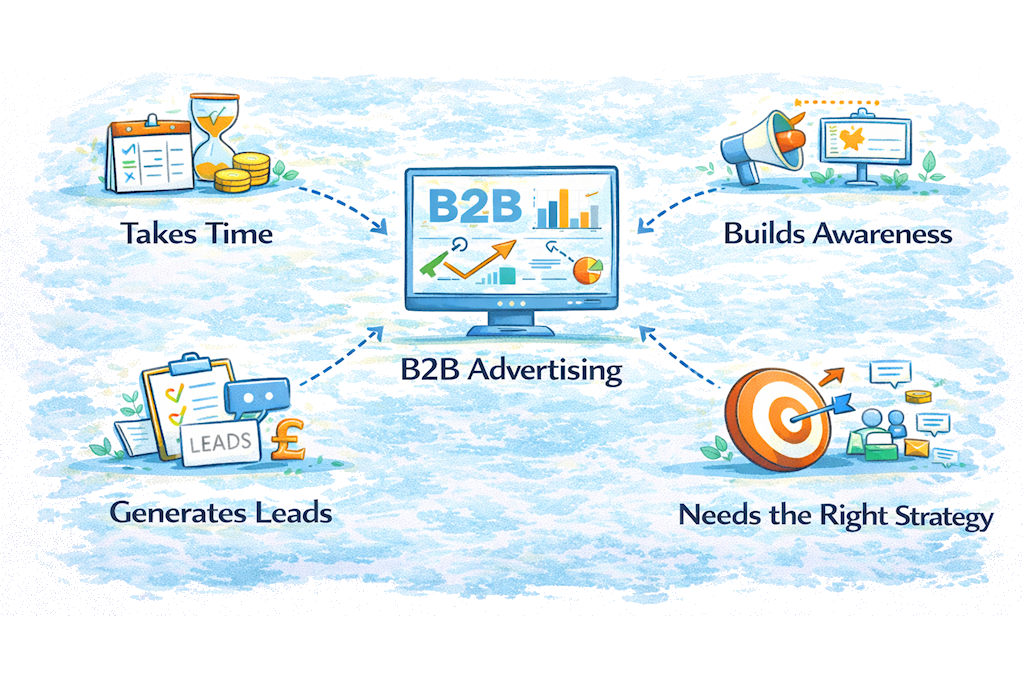
Marketing rarely produces immediate results, particularly in B2B markets where buying decisions can take weeks or months.
Some activities, such as paid advertising, can generate enquiries relatively quickly. Others, including content marketing, SEO and brand-building, often take longer to gain momentum. In many cases the benefits of these activities accumulate gradually over time.
Rather than expecting instant outcomes, it is usually more realistic to look for consistent improvement over several months, with increasing enquiries, better lead quality and stronger brand visibility.
There is no single metric that defines marketing success.
However, the most meaningful indicators tend to be those closest to commercial outcomes. These include the number of enquiries generated, the quality of leads, conversion rates from enquiry to sale, and the overall cost of acquiring new customers.
Metrics such as website traffic or social media engagement can provide useful signals, but they are most valuable when viewed as part of a wider picture that ultimately connects marketing activity with revenue.
Marketing measurement can be challenging because customer journeys are rarely simple.
A potential customer may encounter a business through several different touchpoints before making a purchase. They might read an article, visit the website multiple times, see a social media post and then speak to a colleague before finally contacting the company.
Because of this, it can be difficult to attribute a sale to a single marketing activity. Instead, it is usually more helpful to view marketing performance as the combined effect of multiple interactions that gradually build trust and awareness.
The principles of marketing measurement are broadly the same for organisations of any size.
However, smaller businesses often benefit from focusing on a smaller number of key indicators. Tracking enquiries, monitoring conversion rates and understanding where new customers originate can provide a surprisingly clear picture of marketing performance.
Simple measurement systems are often more useful than complex dashboards. What matters most is having enough insight to understand which marketing activities are producing real business value.